
Summary-
Ants are one of the most stubborn household pests out there. Millions of homeowners try DIY methods every year before calling a professional. This blog breaks down 7 popular home remedies, tests their real effectiveness, explains what actually works, what doesn’t, and when it’s time to bring in expert help. If you’re tired of watching the same trail of ants cross your kitchen counter, read this first.
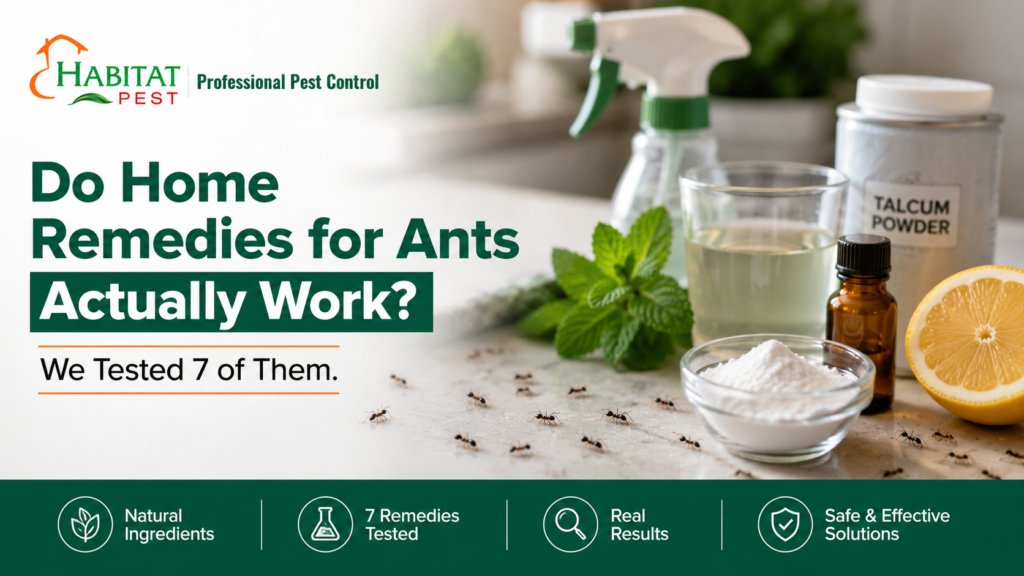
Do Home Remedies for Ants Actually Work? We Tested 7 of Them
Ants don’t just show up randomly. They follow pheromone trails left by scouts, and once a trail is established, hundreds more follow. That’s what makes them so frustrating. You kill ten, and thirty more appear an hour later. So people turn to home remedies, vinegar, baking soda, cinnamon, and more. But do these actually kill ants in the house, or are they just keeping the internet busy? We tested seven of the most popular ones, and here’s what we found in San Jose.
Why Home Remedies Feel Like They Work (But Often Don’t)
Ants operate as a colony, not as individuals. The workers you see foraging inside your home are only a small fraction of the nest. The queen, who can produce hundreds of eggs daily, stays hidden deep in the colony. Most home remedies only target the visible ants, not the source. That’s the core reason people feel like they’re making progress, but the problem keeps coming back.
A surface-level fix rarely reaches the colony. And that gap between “looks like it’s working” and “actually solved” is where most DIY ant control falls apart.
The 7 Home Remedies, Tested and Rated
1. White Vinegar
Vinegar is probably the most recommended ant remedy on the internet. It works by disrupting the pheromone trails ants use to navigate. Spray a 50/50 mix of white vinegar and water along baseboards, countertops, and entry points, and you’ll see ants scatter. It also cleans surfaces as a bonus.
The honest verdict: vinegar repels, it doesn’t kill. Once it evaporates, the effect is gone. Ants reroute and come back. It’s useful as a short-term deterrent and for wiping down surfaces after an infestation is handled, but it won’t solve the problem on its own.
2. Baking Soda and Sugar
This one actually has some science behind it. The idea is to mix equal parts baking soda and powdered sugar. Sugar attracts the ants, and when they ingest the baking soda, it reacts with their acidic digestive system and kills them. Worker ants carry the bait back to the nest, which theoretically affects the colony over time.
In practice, results are inconsistent. Baking soda is less potent than boric acid or borax, and there’s limited scientific evidence backing its effectiveness at the colony level. It may reduce ant numbers slowly, but for a moderate to large infestation, it’s not strong enough on its own.
3. Diatomaceous Earth
Food-grade diatomaceous earth (DE) is one of the more legitimate natural options on this list. It’s a fine powder made from fossilized algae shells, and it works mechanically, not chemically. When ants walk through it, the microscopic sharp particles damage their exoskeleton and cause them to dehydrate and die.
It works, but slowly. DE needs to stay dry to be effective, and it only kills ants that physically walk through it. It won’t reach the colony unless placed directly along active ant trails and near entry points. Still, it’s one of the better non-toxic options for managing ant movement indoors.
4. Peppermint Oil
Peppermint oil has a strong scent that interferes with ants’ ability to detect pheromone trails. Mix around 10 to 15 drops into a spray bottle of water and apply it around window sills, doorframes, and cracks. It smells good, it’s non-toxic, and ants do seem to avoid freshly treated areas.
The limitation is the same as vinegar. Once the scent fades, usually within a day or two, ants return. Peppermint oil is a decent preventive measure in combination with other methods, but as a standalone fix, it’s not reliable enough.
5. Borax Bait
Borax is a step up from baking soda. Mix one part borax with three parts powdered sugar, add a little water to make a paste, and place it near active ant trails. Borax disrupts ants’ digestive and nervous systems. Because it works slowly, worker ants carry it back to the colony before dying, which increases the chance of reaching the queen.
This method genuinely works for many common ant species, including sugar ants and odorous house ants. It takes patience, usually one to two weeks, and the bait needs to stay fresh. Keep it away from pets and children, as borax can be harmful if ingested in large amounts.
6. Lemon Juice
Lemon juice works similarly to vinegar. Its acidity masks scent trails, and the citrus smell discourages ants from crossing treated areas. Squeeze fresh lemon juice along entry points, door frames, and windowsills, or dilute it in water as a spray.
Effective? Temporarily, yes. Long-term, no. Lemon juice evaporates fast and has zero impact on the colony. It’s a good complementary measure but not a solution by itself.
7. Dish Soap and Water
A spray bottle filled with water and a few drops of dish soap kills ants on contact. The soap breaks down the waxy coating on their exoskeleton, causing rapid dehydration. Spray directly on visible ants and trails.
It works instantly on the ants you can see, which makes it satisfying to use. But this is purely a surface kill. It does nothing for the nest, and the colony replenishes those lost workers within hours. Think of it as a temporary clean-up tool, not a control strategy.
What These Remedies Have in Common
Every single remedy on this list shares one limitation: none of them reliably eliminates the colony. They repel, they kill surface ants, they slow trail activity, but the queen keeps producing. That’s the biological reality of ant infestations that most DIY content glosses over. A colony can survive significant surface disruption and bounce back within days.
Home remedies work best as preventive tools or as a way to manage very minor, early-stage activity. For an established infestation, they buy time; they don’t solve the problem.
Signs the Problem Is Bigger Than a Home Remedy Can Handle
Some infestations need professional attention. A few things worth watching for:
• Ant trails appearing in multiple rooms, not just the kitchen
• Ants returning within hours of treatment, day after day
• Visible structural damage to wood, which can signal carpenter ants
• Finding ant nests inside walls, under flooring, or near electrical outlets
• Large numbers of winged ants, called swarmers, are inside the home
If any of these sound familiar, home remedies won’t cut it. A licensed pest inspector in Cupertino or your local area can identify the species, locate the colony, and apply targeted treatments that reach the source.
Straight Answers to Common Questions About Ant Remedies
Q1. Does vinegar kill ants or just repel them?
A1. Vinegar repels ants by masking their pheromone trails, but it doesn’t kill them. Once it evaporates, its effect disappears. It’s useful for surface cleaning and short-term deterrence, not for controlling an infestation.
Q2. Is diatomaceous earth safe to use around kids and pets?
A2. Food-grade diatomaceous earth is generally considered safe for humans and pets when used correctly. The main risk is respiratory irritation if inhaled in large amounts, so apply it carefully and avoid spreading it in areas where kids or pets spend a lot of time.
Q3. How long does borax bait take to work?
A3. Borax bait typically takes one to two weeks to show significant results. It works slowly by design, giving worker ants time to carry it back to the colony. Patience matters here, and the bait should be refreshed every few days.
Q4. Can home remedies eliminate an ant colony?
A4. Rarely. Most home remedies target the ants you see, not the queen or the core of the nest. Borax bait comes closest to reaching the colony, but results vary depending on the ant species and infestation size. A full colony elimination almost always requires professional pest control.
Q5. Why do ants keep coming back after treatment?
A5. Because the queen is still alive and producing eggs. Surface treatments, sprays, and repellents don’t reach deep into the nest. Until the queen is eliminated, the colony regenerates. This is the core reason recurring infestations happen even after repeated DIY attempts.
Q6. What attracts ants into a home in the first place?
A6. Food residue, moisture, and accessible entry points are the main attractants. Ants are drawn to sugar, grease, protein, and standing water. Even small crumbs or a leaky pipe under the sink can bring them in. Sealing cracks and keeping surfaces clean reduces the risk significantly.
Q7. Are carpenter ants more dangerous than regular house ants?
A7. Carpenter ants are more damaging. Unlike termites, they don’t eat wood, but they excavate it to build nests, which weakens structural timber over time. They’re usually larger than common house ants and are often found near moisture-damaged wood. A professional inspection is strongly recommended if you suspect carpenter ants.
Q8. When is the right time to call a pest control professional?
A8. When the infestation keeps returning despite repeated treatment, when you find nests inside walls or under flooring, or when you’re dealing with fire ants or carpenter ants. These species are harder to control and carry higher risks; fire ants sting, and carpenter ants damage structures. Early professional intervention saves a lot of trouble.
Ants Found a Way In. We’ll Find a Way Out.
Habitat Pest Control has come up with a team of pest inspectors in Cupertino. They use targeted treatments based on the specific ant species and colony location, so the problem gets solved at the root, not just the surface.
If ants are making themselves at home in yours, we’re here to change that.