
Summary-
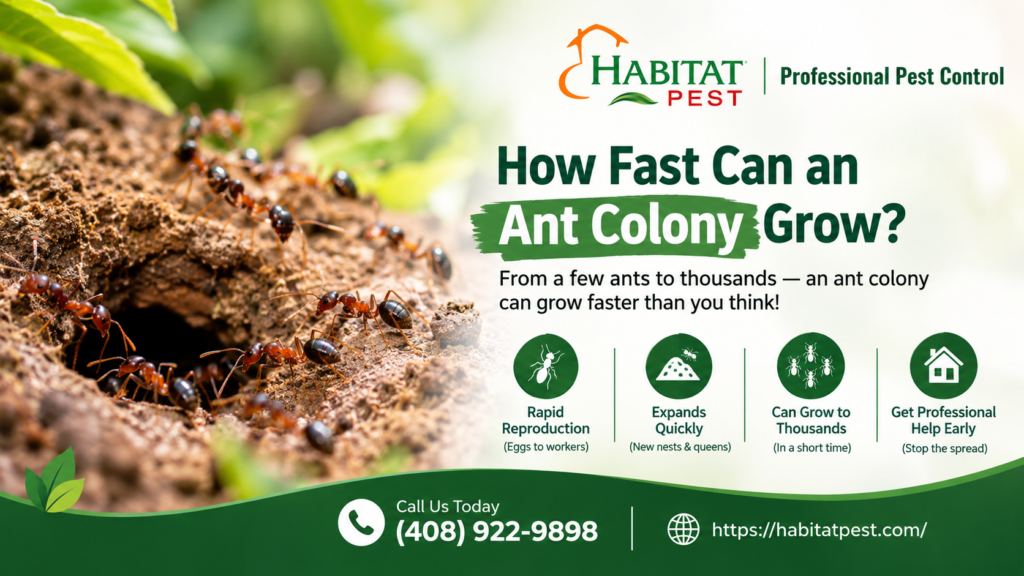
Ant colonies can grow from a small group into thousands of ants as the queen continues producing eggs and worker ants raise each new generation. The speed depends on the ant species, food, moisture, temperature, and nesting conditions. This is why a few ants inside your home can sometimes become a much larger problem if the colony remains active nearby.
A Small Ant Problem Can Become Much Bigger
An ant colony can grow steadily as queens lay eggs and workers care for new generations. Some queens can live for years and produce thousands of eggs.
That is why killing the ants you see may not solve the problem. The main colony could be hidden under soil, inside a wall, beneath a slab, or around damp wood.
For recurring infestations, a pest service in Santa Clara can help identify the source and address the colony rather than only the visible ants.
How an Ant Colony Starts
A new colony often begins when a fertilized queen leaves an established colony and finds a suitable place to build a nest. She lays her first eggs and cares for the early brood until enough workers develop to take over those tasks. After that point, the queen can focus mainly on producing more eggs. (Penn State Extension)
The young ants pass through four main stages:
• Egg
• Larva
• Pupa
• Adult
Workers feed and care for the larvae, while the queen continues producing eggs. As more workers become adults, the colony gains more ants that can search for food and help maintain the nest. (EPA NEPIS)
This creates a cycle. More workers can collect more food. More food supports more developing ants. More workers then become available to support another generation.
How Quickly Can the Numbers Increase?
Ant colonies grow at different rates depending on the species. Pavement ant workers may take about two to three months to develop, while carpenter ant workers can take at least 60 days to reach adulthood.
So, the number of ants may build gradually over weeks or months rather than increasing dramatically in just a few days. Once workers find a reliable food or water source, however, you may suddenly start seeing more ants around kitchens, pantries, pet-food areas, or damp spaces.
Why Some Colonies Grow Faster Than Others
Food is only one part of the equation. Ant colonies also need suitable nesting conditions and enough workers to care for the developing brood.
Several factors can affect colony growth:
• Food availability: Sugar, grease, insects, plant material, and other food sources can support different ant species.
• Moisture: Some ants prefer damp areas and may nest near leaks, wet soil, decaying wood, or other moisture sources.
• Temperature: Ant activity and development can change as temperatures rise or fall.
• Nest conditions: A protected nesting location gives the colony a better chance to survive and expand.
• Number of queens: Many ant species have one queen, but some species can have multiple queens. That can allow a colony or connected group of colonies to expand in unusual ways. (Penn State Extension)
This last point is especially important. Not every ant infestation follows the simple pattern of one queen producing one colony. Species identification can change how an infestation should be handled.
Why You May Suddenly See Hundreds of Ants
Seeing hundreds of ants does not mean they suddenly appeared inside your home. The colony may have been growing unnoticed in walls, cracks, soil, landscaping, or other protected areas.
A new food or water source, changing weather, or an easier entry point can suddenly increase activity. You may then notice ants around a sink, countertop, window, or crack.
The visible ants are often only part of the problem.
When Does an Ant Colony Become a Serious Problem?
A few ants outside are not automatically a reason for concern. Ants play useful roles in the environment and many species rarely cause problems inside buildings.
The concern increases when ants repeatedly enter the house, appear in several rooms, return after cleaning, or continue showing up despite basic prevention.
Carpenter ants deserve particular attention because they can nest in damp, damaged, or decaying wood. Established carpenter ant colonies can contain thousands of workers, and winged reproductive ants generally appear only after a colony has matured for several years. (Penn State Extension)
Repeated indoor activity is a good reason to identify the species and look for the nesting area instead of focusing only on the ants that are easy to see.
Why Killing Visible Ants May Not Stop Colony Growth
Spraying an ant you see can remove that individual ant. It does not necessarily remove the queen, eggs, larvae, or other workers inside the nest.
That distinction matters.
Some ant-control methods rely on workers carrying bait back to the colony. The material can then reach other colony members. Certain slower-acting baits are designed to allow workers time to share the bait before they die. (Penn State Extension)
The correct approach depends heavily on the ant species and where the colony is located. Using the wrong treatment can sometimes leave the main colony untouched.
How Professionals Approach a Growing Ant Problem
A professional inspection usually starts with clues rather than immediately treating every ant in sight.
The technician may look for:
• Ant trails and entry points
• Food and water sources
• Cracks around windows, doors, and foundations
• Moisture problems
• Nesting areas around landscaping
• Damp or damaged wood
• Signs of activity inside wall or structural spaces
Species identification also matters. Different ants have different nesting habits and food preferences, so the same treatment is not ideal for every infestation. (Penn State Extension)
For homeowners looking for an Ant exterminator in San Jose, this distinction can save time and prevent repeated treatments that only deal with the ants appearing on the surface.
What Homeowners Can Do to Slow Ant Activity
Basic sanitation and maintenance can make your home less attractive to foraging ants. Wipe up food spills quickly, store food in sealed containers, clean pet-feeding areas, and address plumbing leaks or other moisture problems.
Outdoor maintenance matters too. Trim vegetation that touches the structure and remove piles of damp organic material near the house.
These steps can reduce the reasons ants have to visit your property. They may not remove an established colony, though. A persistent infestation needs a closer look at where the ants are nesting and how they are entering the building.
Ant Colony Growth Is About More Than Numbers
The biggest mistake is thinking about an ant infestation only in terms of how many ants you can see.
Ten ants in the kitchen might be ten ants. They might also be ten workers from a much larger colony outside.
The workers are the visible part of a social system that can include a queen, developing brood, food stores, and many other workers hidden from view. Once that system has a reliable food source and a suitable nesting location, activity can continue for a long time.
That is why early attention can make an ant problem much easier to manage.
Ant Colony Growth: What You Need to Know
Q1. How fast can an ant colony grow?
A1. Growth varies by species. Some ants can develop from egg to worker in several weeks, while others take a few months. Pavement ant workers, for example, develop over roughly two to three months. (Penn State Extension)
Q2. How many ants can live in one colony?
A2. Colony size depends on the species. Some colonies remain relatively small, while mature colonies can contain thousands of workers. Carpenter ant colonies can reach around 2,000 to 3,000 workers before producing large numbers of winged reproductive ants. (Penn State Extension)
Q3. Can one queen produce thousands of ants?
A3. Yes. Queens of many ant species can live for years and produce thousands of eggs during their lives. The exact number depends on the species and colony conditions. (Penn State Extension)
Q4. Why are more ants suddenly appearing in my house?
A4. A colony may have been active nearby for some time. Workers can suddenly become noticeable after finding food, water, or an easier path into the building.
Q5. Do ants reproduce inside a house?
A5. Some species can establish nests inside buildings, especially in protected cavities or areas that provide suitable moisture and food. Other ants found indoors may have their main nest outside. (EPA NEPIS)
Q6. Does killing worker ants kill the colony?
A6. Usually, killing individual workers does not remove the queen or developing brood. Some control methods use slow-acting baits so workers can carry the material back to the nest. (Penn State Extension)
Q7. Can an ant colony have more than one queen?
A7. Yes. Some ant species can have multiple queens, and this can make their colony structure different from species that normally have one queen. (Penn State Extension)
Q8. When should I call an ant exterminator?
A8. Consider professional help when ants keep returning, appear in several areas, form regular trails indoors, or seem to be coming from wall voids, foundations, damp wood, or other hidden locations. Species identification can help determine the right control method.
Stop the Problem Before the Colony Gets Bigger
Ant colonies can grow steadily, even when you see only a few workers. If ants keep returning, finding the source is more useful than simply killing the visible ants.
If you need a pest service in Santa Clara, Habitat Pest Control can help identify the source and recommend an approach based on the ant species and infestation location.