
Summary
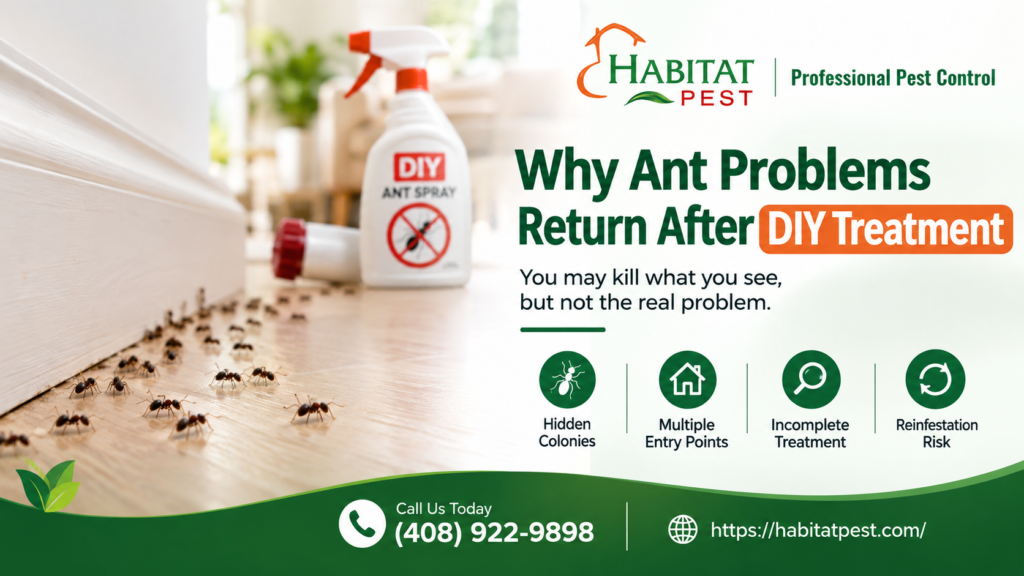
DIY ant treatments can seem successful because they quickly reduce the ants you can see. But visible workers are often only a small part of a much larger colony. If the nest, queens, food and water sources, or entry points remain, the ants may return. Effective ant control focuses on the source of the activity, not just the trail across the counter.
The Ants You See Are Only Part of the Colony
When ants show up in a kitchen, the natural reaction is to spray the trail, wipe the counter, and move on. For a few days, the problem may appear to be gone. Then the ants return.
That happens because the workers you see are usually only a small portion of the colony. They leave the nest to search for food and water, then return to the colony. University of Minnesota Extension notes that killing foraging workers alone usually has little effect on the colony because most ants remain in or near the nest. (University of Minnesota Extension)
The colony itself may be outdoors in soil or landscaping, under a slab, near the foundation, inside a wall void, or in another protected location.
Killing Workers Is Not the Same as Eliminating the Colony
A contact spray can produce fast visible results. It may kill the ants that are out foraging, but it does not necessarily reach the nest or queens.
UC IPM explains that sprays often provide only temporary control when they kill foraging ants without eliminating the colony. More workers can emerge later and resume searching for food. (UC IPM)
This is why repeatedly spraying individual ants can turn into a cycle: the visible ants disappear, but the source remains active.
The Nest May Be Somewhere You Cannot See
A common DIY mistake is treating where ants are visible rather than determining where they are coming from.
Ants may nest outdoors in soil, beneath stones or pavement, near foundations, around plants, or in other protected areas. Some species may also nest inside wall voids, under floors, or near moisture sources. (University of Minnesota Extension)
The trail you see is useful information, but it does not necessarily lead directly to the nest.
Spraying a Trail May Only Interrupt It
Ants use chemical trails to guide other workers to food and water. Spraying a trail may kill the ants currently using it and temporarily disrupt their movement, but the colony still needs resources.
New workers may find another route. That is one reason ants can seem to disappear and then return from a different crack, window, or section of the room.
A more complete approach combines sanitation, entry-point reduction, monitoring, and colony-focused treatment.
The Wrong Bait May Not Work
Ant food preferences vary by species and can change with colony needs and season. Some ants are strongly attracted to sweets, while others may respond better to protein- or grease-based foods.
UC IPM notes that bait effectiveness depends on the species, available food, and bait formulation. (UC IPM)
If ants ignore one bait, it does not necessarily mean baiting is ineffective. The formulation may simply be a poor match for the colony at that time.
Other Food Sources Can Compete With Bait
Even an appropriate bait can be less attractive when ants have easy access to other food.
Crumbs, sugar spills, grease, pet food, ripe fruit, open trash, and food residue can all compete with bait. Water matters too. Leaks, condensation, and standing water can keep ants active in an area.
Before treatment, check for:
• Exposed or spilled food
• Pet food and water
• Accessible garbage
• Plumbing leaks or standing water
• Vegetation touching the structure
• Gaps around doors, windows, pipes, and utility lines
Reducing these conditions can make a control program more effective.
Avoid Spraying Around Ant Baits
Baits are designed to be collected by worker ants and carried back toward the colony. Many baits work slowly so workers have time to feed and share the material.
Spraying insecticide directly around a bait can kill or repel workers before they use it effectively. When baiting, avoid applying repellent sprays in the same area unless the product directions or pest professional specifically call for it.
More pesticide is not always better. Combining products without a plan can interfere with the treatment.
Moisture Can Keep Ants Active
Food gets most of the attention, but ants also need water. A dripping faucet, damp cabinet, plumbing leak, condensation, or moisture near the foundation can make an area more attractive.
UC IPM recommends correcting leaks and reducing easy access to water as part of ant management. (UC IPM)
If ants repeatedly appear beneath a sink, near a bathroom, or around a damp area, the location itself may be an important clue.
Small Entry Points Can Keep the Problem Going
Ants can enter through very small openings around windows, doors, pipes, utility lines, siding, and foundations.
UC IPM recommends locating entry points and sealing appropriate cracks and gaps as part of an integrated ant-management program. (UC IPM)
Exclusion works best alongside colony control. Sealing one opening without addressing the colony may simply cause ants to search for another route.
Why Ants Can Return After They Seem Gone
Ant control is not always immediate. Depending on the species, colony size, treatment method, and conditions around the property, baiting may take days or weeks to produce full results.
A temporary drop in activity is encouraging, but it does not always mean the colony has been eliminated. If large numbers return, the colony may still be active, another nest may be present, or conditions around the property may continue to support the infestation.
A Better Approach to Recurring Ant Problems
Long-term ant management usually combines several steps:
1. Identify the ant. Different species have different nesting habits and food preferences.
2. Trace the activity. Look for trails, entry points, moisture, and likely nesting areas.
3. Reduce competing food and water. Clean spills, store food properly, manage waste, and repair leaks.
4. Target the colony. Use an appropriate treatment strategy rather than relying only on contact sprays.
5. Reduce access. Seal appropriate gaps and manage vegetation or other pathways leading to the structure.
UC IPM describes this type of integrated approach as combining sanitation, exclusion, monitoring, and targeted treatment. (UC IPM)
Frequently Asked Questions
Why do ants come back after I spray them?
Spraying may kill visible workers without eliminating the colony. More workers can later leave the nest and return to the home. (University of Minnesota Extension)
How long does ant bait take to work?
It varies. Depending on the species, colony size, bait, and conditions, meaningful control can take days to several weeks or longer. (UC IPM)
Why are ants ignoring my bait?
The bait may not match their current food preference, or more attractive food may be available nearby. (UC IPM)
Can spraying interfere with ant bait?
Yes. Repellent or fast-acting sprays near bait can reduce feeding or kill workers before they carry bait back toward the colony.
Can ants live inside walls?
Some household ant species can nest in wall voids, under floors, or near moisture inside structures. (University of Minnesota Extension)
Does keeping my house clean prevent ants?
Good sanitation helps reduce food sources, but cleanliness alone may not eliminate an established colony.
When should I call a pest professional?
Consider professional help when ants keep returning, appear in multiple areas, come from hidden spaces, or remain difficult to control after reasonable DIY efforts.
When Ants Keep Finding Their Way Back
Recurring ants usually mean there is still a colony, food or water source, or entry route supporting the activity. For homeowners looking for ant control in Mountain View or the surrounding South Bay, Habitat Pest Control can inspect the pattern, identify likely contributing conditions, and recommend a practical treatment plan based on the situation.