
Summary
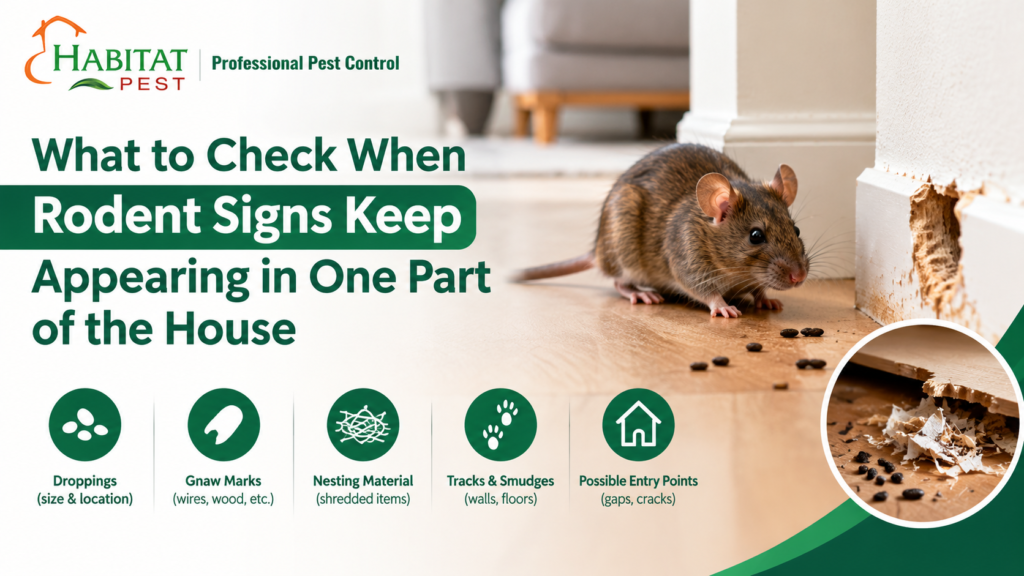
When droppings, gnawing, or scratching keep turning up in the same part of a house, that spot is often part of a route rather than the source. The room next door, the attic above, the roofline, and the yard outside can all explain why the evidence keeps coming back. Roof rats in particular use trees and utility lines to reach the upper parts of a home.
Three weeks in a row, you find droppings in the same kitchen cabinet. You clean them up, set a trap, and a few days later there are more.
The spot you keep cleaning is usually just where the evidence collects. The rodent is getting there from somewhere else, and the answers are in the walls, ceiling, and yard around it. Where you find the signs tells you where to start looking, so this guide is organized by location.
If the Signs Are in the Kitchen
Droppings in a cabinet or behind the stove usually mean rodents are reaching food, but the cabinet itself is rarely where they come in. Empty the affected cabinet and look closely at the back panel and floor. Gaps around the pipes under the sink are one of the most common ways in, and so are openings behind the dishwasher and refrigerator where lines pass through the wall.
Check the cabinets on either side too. Rodents travel through the hidden space behind a run of cabinets, so evidence in one may have come through its neighbor.
UC IPM recommends sealing any opening larger than 1/4 inch. Look at the edges of existing gaps as well, since rodents can chew a small opening wider over time.
If You Hear Scratching Overhead
Sounds in the ceiling at night usually point to the attic. Roof rats are strong climbers, and UC IPM notes they use trees, shrubs, and utility lines to reach roofs before settling into attics, ceilings, and wall spaces.
Up in the attic, look for droppings along the beams, tunnels or flattened patches in the insulation, and chewed wiring or ductwork. Then go outside and check the roofline above that room: roof vents, gaps where the fascia meets the roof, and branches touching or hanging over the house.
Mature trees and dense planting are common on Los Gatos pest control services properties, which gives roof rats an easy path up. Even if the scratching is above a downstairs room, check the attic and roof edge anyway. Roof rats travel high and come down inside the walls.
If It’s the Garage
Garages are full of cover: cardboard boxes, garden supplies, sacks of pet food or bird seed. They’re also easy to get into. Check the seal along the bottom of the garage door, the corners where the door meets the frame, and every spot where pipes, wires, or a dryer vent pass through the wall.
Pull stored items a few inches away from the walls and get them off the floor where you can. Rodents like running along walls behind clutter, and opening up that space makes fresh droppings and gnaw marks much easier to spot.
If It’s Inside a Wall
Scratching or scurrying inside a wall means rodents are using the void as a hallway. Listen for where the sound is loudest. Near the ceiling, the attic is the likely connection. Near the floor, check the crawlspace and foundation vents.
The type of rat matters here. Norway rats stay low, burrow near foundations, and favor crawlspaces and ground-level rooms. Roof rats prefer the upper parts of the house. Knowing which one you have keeps the search pointed in the right direction.
Finish With a Lap Around the House
Wherever the signs are inside, walk the outside of the house before you call it done. Look for:
• Branches or vines touching the roof or walls
• Fruit or nuts on the ground under trees
• Damaged vent screens or crawlspace covers
• Gaps around pipes, cables, and AC lines
• Woodpiles, debris, or dense plants against the foundation
Fallen fruit and open pet food give rodents a reason to stay close. UC IPM suggests picking up fallen fruit, bringing pet food in at night, and keeping garbage in closed containers.
A quick note on your phone each time you find something (the date, the spot, and what it was) makes the pattern obvious within a week or two. Scratching that always comes from the same corner can narrow an attic search down to a few feet.
Common Questions About Recurring Rodent Signs
Q1. If droppings keep showing up in one room, is the nest there?
A1. Not necessarily. The room may simply be on the route, or it’s just the place where evidence is easiest to spot.
Q2. Can I have rats without ever seeing one?
A2. Yes. Rodents are mostly active at night and can stay hidden in attics, wall voids, and crawlspaces. Droppings and sounds usually show up long before a sighting.
Q3. Is it safe to sweep up rodent droppings?
A3. No. Avoid sweeping or vacuuming them dry, since that can stir contaminated dust into the air. The CDC recommends a wet cleanup instead. Put on rubber or plastic gloves, then spray the droppings and any urine with a bleach solution (1 part bleach to 9 parts water) or an EPA-registered disinfectant until they are very wet. Let it soak for five minutes, or for the time listed on the disinfectant label.
Wipe everything up with paper towels and throw the towels away in a covered garbage can that gets emptied regularly. Then disinfect the surrounding floors, counters, and cabinet surfaces. Wash your gloved hands with soap and water or disinfectant before taking the gloves off, then wash your bare hands with soap and warm water.
Q4. Should I worry about gnawing near wires?
A4. Yes. Chewed wiring can be a fire risk. Leave the area alone and have it checked instead of reaching into concealed wiring yourself.
Q5. Does rodent activity change with the seasons?
A5. It can. Weather, food supply, and vegetation around the property all shift during the year, so a quiet area can become busy later on.
Q6. When is it time to call a pest exterminator?
A6. Signs that return after cleanup, scratching you can’t trace, evidence in places you can’t reach, or a suspected entry point you can’t seal yourself are all good reasons to bring someone in.
Start One Room Over
The droppings you keep cleaning up are the last stop on the route. Look one room over, one floor up, and one step outside, and you’ll usually find how they’re getting in.
When the signs keep returning anyway, Habitat Pest Control offers pest control services for recurring rodent activity and focuses on the conditions behind it, not just the latest evidence.