
Summary-
Think your clean, sealed home is safe from ants? Think again. Ants can squeeze through a gap as small as 1/64 of an inch, and they’re far smarter about finding ways in than most people realize. This blog breaks down exactly how ants locate and enter homes, what draws them inside, and what genuinely stops them, including when a professional ant control service in San Jose, CA, becomes the only real fix.
Your Home Isn’t as Sealed as You Think
A spotless kitchen, sealed food containers, and no visible cracks in the walls. And yet, ants still show up. This is one of the most frustrating things homeowners deal with, and it happens more often than you’d think. The problem isn’t that you’re doing something wrong. The problem is that ants are exceptionally good at finding ways in, and most homes aren’t as sealed as they appear. Understanding how they do it is the first real step toward stopping them.
Entry Points That Are Easier to Miss Than You Think
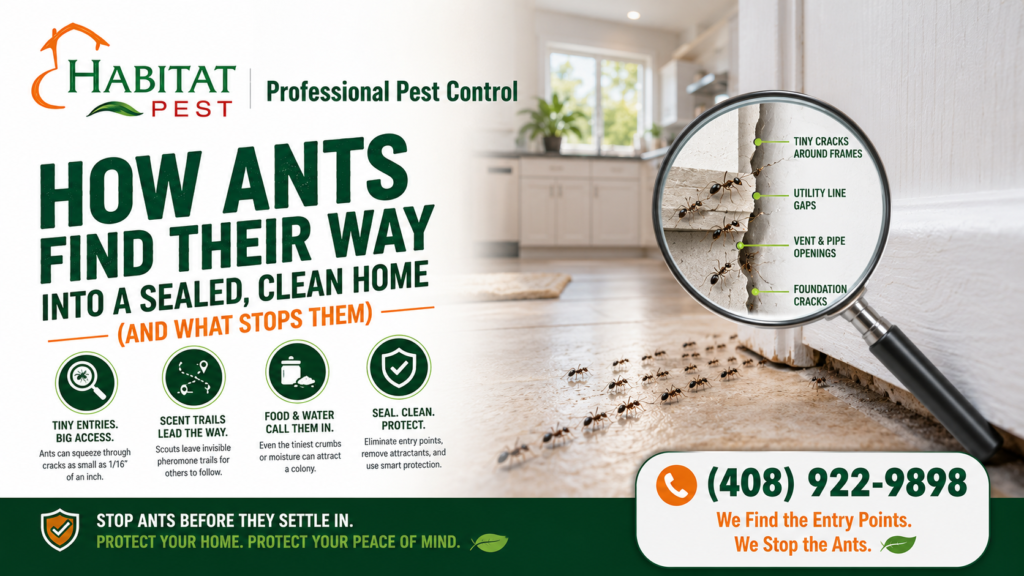
Most homeowners check the obvious spots, window frames, door edges, and visible cracks in walls. But ants use a much wider range of access routes, many of which are practically invisible to the naked eye.
The Entry Points Professionals Check First
• Utility line gaps: Every home has openings where electrical wiring, plumbing, cable lines, and gas pipes enter through the wall. These penetrations are rarely sealed completely tight, and even a small gap around a pipe is more than enough for most ant species.
• Foundation hairline cracks: Natural settling causes tiny fractures in concrete foundations over time. Pavement ants and Argentine ants exploit these routinely, especially after rain softens the surrounding soil.
• Weatherstripping wear: Door seals and weatherstripping degrade with use and age. A door that looks closed may have a gap at the bottom or sides that ants can pass through without any difficulty.
• Roof and soffit gaps: Carpenter ants in particular enter through roof lines, damaged fascia boards, and gaps near gutters, especially where moisture has softened surrounding wood.
• Air vents and weep holes: These are built-in openings in a home’s structure. Without fine mesh screens, they function as open doors for small ant species like pharaoh ants and odorous house ants.
The UC IPM (University of California Integrated Pest Management) program confirms that ants strongly prefer to trail along structural elements like pipes and wires, using them as internal highways once they’re inside. That’s why infestations often appear far from the actual entry point.
Your Home Attracts Ants Even When It Feels Clean
Here’s something most people don’t know: ants aren’t just looking for crumbs. They’re also drawn to moisture, warmth, and shelter opportunities. A spotless home can still offer all three.
A slow drip under the kitchen sink, condensation around a poorly insulated pipe, or excess humidity in a bathroom wall cavity is enough to attract moisture-seeking species like odorous house ants and carpenter ants. Even a pet water bowl left out overnight creates a reliable water source that scout ants will find and report back to the colony.
Grease residue on stovetops, the faint smell of ripe fruit in a bowl, or crumbs that fell behind a drawer are all signals ants detect through their antennae at concentrations humans can’t smell at all. Their sensory detection is remarkably sensitive, which is why “clean” by human standards and “clean” by ant standards are two very different things.
Why Vegetation Around Your Home Makes Things Worse
The outside of your home matters just as much as the inside. Tree branches touching your roofline, shrubs pressed against the foundation, and ground cover growing close to the walls all create direct physical pathways for ants to reach your home without ever touching the ground.
Carpenter ants are known to use overhanging tree limbs as bridges into roof spaces. Argentine ants, one of the most invasive species in California, trail along plant stems and mulch beds right up to foundation walls and through whatever gap they find first.
Keeping vegetation trimmed back at least a foot from the structure removes these routes and makes perimeter treatments from a professional ant exterminator in San Jose significantly more effective.
When Sealing and Cleaning Isn’t Enough
There’s a point where DIY approaches stop working, and it usually comes down to the size and location of the colony. If the nest is inside a wall void, under flooring, or beneath a concrete slab, surface treatments and exclusion work won’t reach it. The colony simply reroutes and finds another way in.
Multi-queen species like Argentine ants and pharaoh ants are especially difficult to eliminate without professional intervention. Pharaoh ants are known to “bud” when threatened, meaning the colony splits into multiple new colonies and spreads further into the structure. Using the wrong treatment on pharaoh ants can make an infestation significantly worse.
A professional ant control service in San Jose, CA, starts with species identification, which determines both the nest location strategy and the correct bait or treatment type. From there, targeted applications reach areas that no over-the-counter product is designed to access.
Everything You’ve Been Wondering, Answered Directly
Q1. How small a gap can ants fit through?
A1. Most common household ant species can squeeze through a gap as small as 1/64 of an inch, roughly 0.4 millimeters. Pharaoh ants and little black ants need even less space. Larger species like carpenter ants need about 1/8 of an inch, which is still smaller than most people would notice without specifically looking.
Q2. Why do ants keep coming back to the same spot even after I clean it?
A2. Pheromone trails are the reason. Even after you remove the ants, the chemical signal they left behind stays on the surface. New ants follow it until it’s physically removed. Cleaning the area with soapy water or a diluted vinegar solution breaks down the trail and disrupts the signal.
Q3. Can ants come through a concrete slab foundation?
A3. Yes. Hairline cracks from natural settling, expansion gaps, and the joints where the slab meets the wall are all common entry routes. Pavement ants are especially known for nesting directly under and within concrete slabs and exploiting these gaps.
Q4. Does keeping a clean kitchen guarantee ants won’t come in?
A4. Not entirely. Ants are also drawn to moisture, warmth, and shelter, not just food. Even a home with no accessible food can attract species looking for nesting sites or water sources. A dripping pipe, humid wall cavity, or damp wood is enough to bring certain species in regardless of how clean the kitchen is.
Q5. What’s the difference between baiting and spraying for ants?
A5. Spraying kills ants on contact but doesn’t reach the colony. It reduces what you see but leaves the source intact. Baiting uses a slow-acting toxicant that worker ants carry back to the nest and share with others, including the queen. It takes longer to show results but targets the colony at its root.
Q6. Why do ants suddenly appear after rain?
A6. Rain saturates the soil around ant nests, flooding colonies and forcing them to relocate or forage indoors. It also softens the ground around foundations, making it easier for ants to exploit existing cracks. Post-rain ant activity is extremely common and a reliable indicator that nests are located close to the structure.
Q7. Are carpenter ants more dangerous than regular ants?
A7. Carpenter ants don’t eat wood the way termites do, but they excavate it to build galleries for nesting. Over time, this weakens structural wood, especially in areas already softened by moisture. Left unchecked, a mature carpenter ant colony can cause serious property damage. They also tend to have satellite nests spread across multiple locations in the same building.
Q8. When should I stop trying DIY fixes and call a professional?
A8. When the problem returns repeatedly within a few weeks, when you’re seeing ants in multiple rooms rather than one area, or when you find signs of nesting inside walls or structural wood, DIY fixes won’t solve it. Those are signs the colony is already established inside the structure and needs targeted professional treatment to eliminate.
Ants Are Smarter Than the Gap You Sealed
The entry point you caulked last spring may have done its job. But there are dozens more around a typical home that most people never inspect. Ants are patient, systematic, and always looking. They’ll find the one you missed.
Habitat Pest Control inspects the full perimeter, identify the species, locate active trails and nesting sites, and apply treatments that work at the colony level, not just the surface. Our approach to ant control service in San Jose, CA, is created around stopping the source, not managing the symptoms. If the same ants keep coming back no matter what you try, that’s exactly the situation we’re built for.