
Summary
A sudden jump in spider webs usually says more about the conditions around your house than about the spiders themselves. More insects, quiet sheltered corners, and outdoor lighting can all draw web-builders to the same spots. Here’s what the webs can tell you, and when spider removal is worth considering.
Did the porch light, the garage door, and the corner of the patio all seem to sprout webs at once? A jump like that usually has less to do with spiders and more to do with what’s changed around your house. The webs themselves carry most of the clues, if you know what to look at.
First, some reassurance. According to UC IPM, most spiders around California homes are harmless and actually help by eating insects. More webs are not proof of an infestation.
Clue 1: Where the Webs Are Clustered
One web beside a window doesn’t say much. A cluster along one side of the house does. Common hot spots include outdoor lights, the eaves, garage doors and vents, and the narrow gap between shrubs and the exterior wall.
When webs bunch up in one area, that spot is offering spiders something: food, shelter, or good anchor points for silk.
Clue 2: What’s Caught in Them
Web-builders wait for food to come to them, so they set up where insects already gather. Look at what’s trapped in the silk. Plenty of moths and gnats near a porch light tell you the light is the real draw, a connection UC IPM also points out between outdoor lighting, insects, and spider activity.
If that’s what you’re seeing, turn off lights that don’t need to be on, or keep them away from doors and windows. Reducing insects can reduce spider activity.
Clue 3: The Shape of the Web
Different spiders build very different webs, and some build none at all:
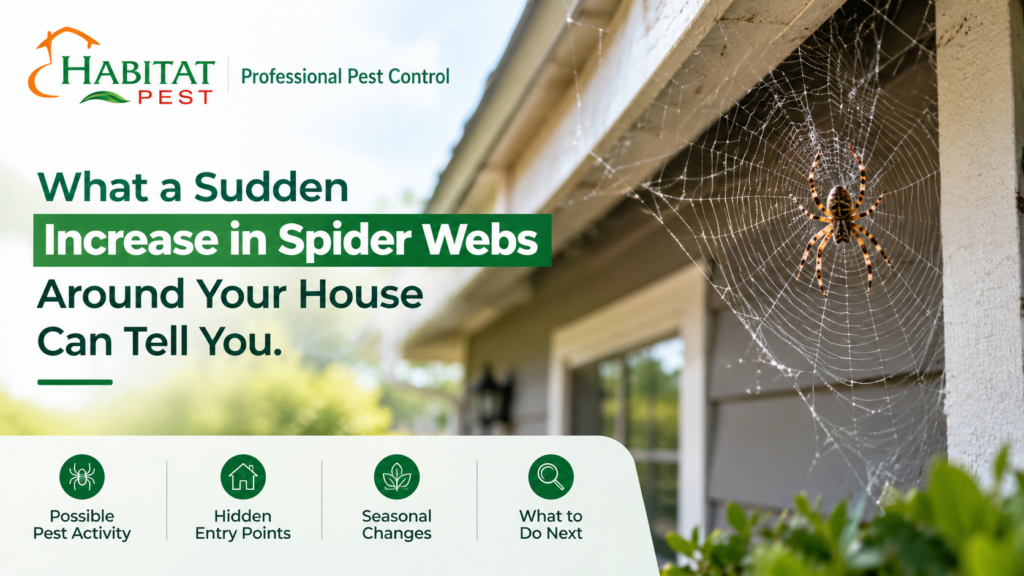
• Round, spoked webs come from orb weavers, which usually catch flying insects in gardens and across paths.
• Tangled, messy webs belong to cobweb spiders, a group that includes black widows.
• Flat sheets that narrow into a tube are made by funnel weavers, which wait inside the tube.
• No web at all is typical of wolf spiders and jumping spiders, which hunt on foot. A yard can have plenty of spiders and very few webs.
Web shape narrows down the group. It won’t confirm the species.
Clue 4: Webs That Come Back
Clear a web and find a new one in the same corner two days later? That corner suits the spider. It’s probably dry, quiet, close to insects, and full of places to attach silk.
Knocking webs down only handles what you can see. Changing the spot does more: trim plants back from the walls, rake leaf litter away from the foundation, lift stored items off the ground, and seal cracks around doors and windows. UC IPM recommends the same steps because they reduce both spiders and the insects they feed on.
A Word About Garages and Black Widows
Garages have quiet corners, stored belongings, and gaps around doors, which makes them good shelter for several species. UC IPM notes that adult female black widows in California are commonly found in dry, sheltered, undisturbed places such as garages and woodpiles. Their webs are irregular and made of noticeably tough silk.
A messy web alone won’t tell you a black widow made it, and getting close to the spider to check isn’t worth the risk. If you suspect one, observe it from a safe distance without touching it or its web, or have it professionally identified. The adult female is shiny black with a red hourglass marking on the underside of her abdomen, a marking you often can’t see from above.
Wear gloves when moving boxes or firewood, and look before reaching into dark corners.
Around Morgan Hill Yards
Patios, fences, sheds, firewood stacks, and landscaped beds give spiders plenty of sheltered places to build on a typical Morgan Hill property. Webs multiplying around a back shed usually have a different explanation from webs at a bedroom window, so look at each area on its own instead of assuming one cause for everything.
When to Get Help
If webs keep returning around doors, patios, or storage areas you use every day, or you’re finding spiders you can’t identify in dark corners, spider removal may be worth it. Habitat Pest Control handles spider activity as part of our pest control service for Morgan Hill and nearby communities, and we start by finding out what’s attracting them.
Spider Web FAQs
Q1. Do more webs mean I have a spider infestation?
A1. No. Webs alone don’t prove that. Live spiders, how often the webs return, and where they appear are better clues.
Q2. Should I remove every web outside?
A2. Not necessarily. Many spiders help keep insect numbers down. Clearing webs around doors, walkways, and patios makes sense, while a web on a back fence may not need any attention.
Q3. Can spiders come indoors from webs outside?
A3. Some wander in through gaps around doors, windows, and vents, especially near lights. Sealing those gaps and fitting door sweeps helps.
Q4. Why do webs seem to multiply in late summer and fall?
A4. Many outdoor spiders reach full size toward the end of summer, so their webs get bigger and easier to notice, especially orb webs strung across paths and porches.
Q5. Are spider bites common?
A5. Most spiders around homes rarely bite people. California’s main spider of medical concern, the black widow, tends to stay hidden, and bites usually happen when someone reaches into a spot where one is sheltering.