
Summary
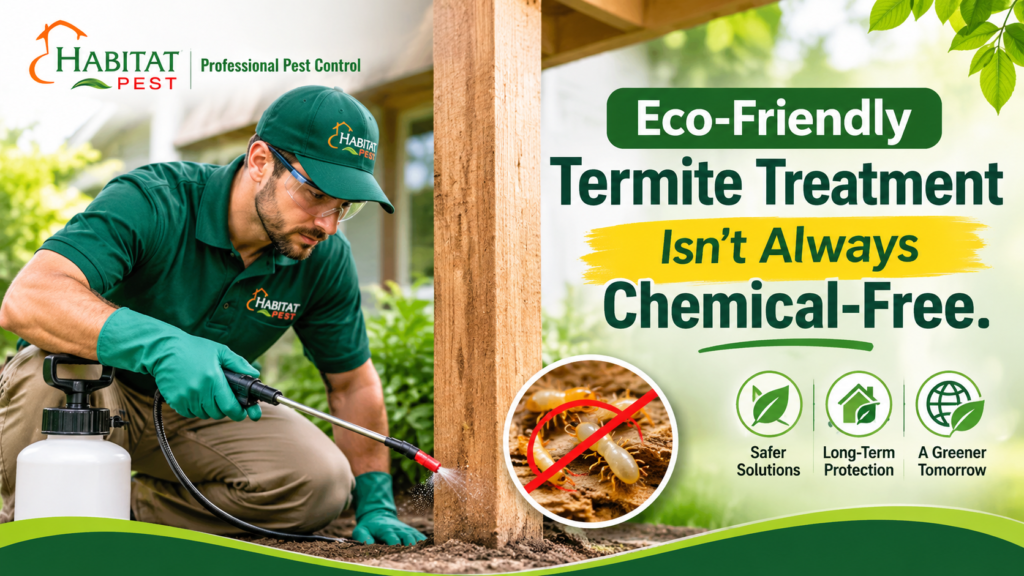
“Eco-friendly” is a marketing label, not a defined treatment category, and it doesn’t necessarily mean no pesticide is used. Heat and repairs use none, while spot treatments, baits, orange oil, and fumigation all rely on a pesticide of some kind. This guide shows which options use pesticides and where each one falls short, so homeowners around San Jose can compare them on facts rather than labels.
A lot of people hear “eco-friendly” and picture a treatment with no pesticide at all. With termites, that’s sometimes possible and often not.
In practice, what gets sold as eco-friendly termite treatment usually means using less product and putting it only where it’s needed, or skipping pesticide where a nonchemical method can do the job. That might be treating just the infested boards, using bait that termites eat from a station instead of treating the soil around the structure, choosing heat where it will work, or fixing the moisture problems that invited termites in. Every one of those has limits, and the label alone won’t tell you what they are.
California has been studying this closely. In February 2026, the California Department of Pesticide Regulation released findings from an independent study showing that localized chemical and nonchemical treatments are already in use, but that effective alternatives for widespread, hidden drywood termite infestations are still limited.
The Options at a Glance
| Method | Uses pesticide? | Best suited to | Main limitation |
|---|---|---|---|
| Spot (localized) treatment | Yes, usually small amounts of insecticide applied into the infested wood | Drywood colonies that can be found and reached | Only treats the activity the inspection found; missed areas keep feeding, results vary by product, and residue remains |
| Heat | No | Drywood termites in areas that can be heated evenly | No lasting protection; heat-sensitive items like plastics and wiring can be damaged, and concrete or tile can leave cool spots |
| Baiting | Yes, an insecticide contained in monitored stations | Subterranean termites | Termites must find and feed on the bait, so results can take months and stations need regular checks |
| Orange oil products | Yes, a plant-derived pesticide (d-limonene) | Small, accessible drywood areas | Lab and field testing has questioned its effectiveness; it only reaches wood it's applied to |
| Fumigation (tenting) | Yes, a fumigant gas (sulfuryl fluoride) | Widespread or hidden drywood colonies | The whole house must be vacated and tented; no lasting protection against new colonies |
| Repairs and moisture fixes | No | Conditions that attract subterranean termites | Won't eliminate an active colony on their own |
First, Which Termite Do You Have?
The two main types behave so differently that no single method fits both.
Drywood termites live entirely inside wood. Colonies can sit in walls, framing, furniture, and trim without ever touching soil, and they push out small, hard pellets that pile up beneath tiny holes. Subterranean termites nest in the ground and travel up into the structure, often building pencil-width mud tubes along the foundation.
A house with activity confined to a few reachable boards is a very different job from one with signs in several hidden areas. Older homes, additions, decks, garages, and crawlspaces all make finding and reaching termites harder.
Why the Inspection Matters So Much
Spot treatment targets confirmed activity instead of the whole building, so less product is used overall. The catch is what nobody can see. Drywood colonies can extend into ceilings and wall cavities beyond the evidence found during an inspection, and UC IPM points out that the success of localized drywood treatments depends heavily on locating the entire infestation. Any part that’s missed keeps feeding.
A good spot treatment is only as reliable as the inspection behind it.
Heat and Bait, Up Close
Heat is one of the more established nonchemical methods for drywood termites, and UC IPM recognizes it for both spot and whole-structure treatment. The wood is brought up to a temperature that kills the termites inside. It leaves no protection behind once the house cools, thick beams take longer to heat through, concrete and tile can absorb heat and leave cool spots, and some belongings can’t tolerate high temperatures.
Bait is still a pesticide method, just a contained one. Subterranean workers feed on insecticide-treated bait and share it with the colony, so the stations need regular checks over weeks or months. UC research has tested bait systems in several California counties, including Alameda, Contra Costa, and Santa Clara, so there’s local data behind the approach.
About Orange Oil
Orange oil is often marketed as a natural termite solution, but it’s still a pesticide. Its active component, d-limonene, is plant-derived, and UC IPM notes that university lab and field testing has raised questions about how well it actually controls drywood termites. Plant-based and proven are two different things, so ask for evidence before relying on it.
The Tenting Question
For many homeowners in San Jose and the surrounding cities, the real question is simple: can this be handled without tenting the whole house?
Sometimes, yes. When drywood activity is limited and easy to reach, a localized method can be a reasonable fit. Hidden colonies are another matter. Fumigation reaches termites throughout the structure, and UC IPM describes it as highly effective when done properly, though it uses a fumigant gas and leaves no protection against future colonies. The 2026 state study reached a similar conclusion about its reach, finding few viable alternatives to whole-structure fumigation for widespread infestations.
Avoiding a tent is a fair thing to want, but the method you choose still needs enough reach for the infestation you actually have.
Questions to Ask Before You Agree to Anything
• Which termite species was found?
• Where exactly is the activity, and how was it located?
• How far might it extend into walls or ceilings?
• What method and products are being proposed?
• What follow-up visits or monitoring come with it?
Termite Treatment FAQs
Q1. Is heat treatment completely chemical-free?
A1. Yes. It relies on heat alone, though the structure and its contents need to be suitable for it.
Q2. Can every termite problem be handled without fumigation?
A2. No. Spot and nonchemical methods work in the right situations, but widespread or hidden drywood colonies may need whole-structure treatment.
Q3. Does a termite swarm mean my house is infested?
A3. A swarm inside the house usually means a colony is in or very near the structure. Swarmers outdoors may be coming from a colony in the yard. Either way, it’s worth having the area checked.
Q4. How long does a termite bait system take to work?
A4. It varies. Termites first have to find the stations and start feeding, so it can take months, with regular checks along the way.
Q5. Will treatment stop termites from coming back?
A5. Not by itself. Future activity also depends on moisture, damaged wood, soil contact, and other conditions around the home.
Q6. Is a second opinion worth getting?
A6. For a big decision like tenting versus spot treatment, a second inspection can be worthwhile, especially if two reports disagree on where the activity is.
Start With the Infestation, Not the Label
A small, clearly located problem may suit a localized or nonchemical method, while hidden or widespread activity often needs something with more reach. Where the termites are and how confidently that’s been mapped matter far more than any “natural” label on the product.
If you’re weighing options, Habitat Pest Control’s termite inspection and treatment service starts by locating the activity and identifying the species, then explains what each available method involves, including whether it uses a pesticide.