
Summary
Most homeowners focus on kitchen cleanliness to prevent ants, but the garage is often where the real problem starts. Cluttered shelves, unsealed food, and moisture-prone corners give ants everything they need to settle in. An ant exterminator in San Jose will tell you the same thing: storage habits in your garage matter more than most people realize.
The Garage Is the Most Overlooked Ant Entry Point in Any Home
Ants are opportunists. They do not need a messy kitchen or an overflowing trash can to move into your home. The garage gives them exactly what they look for: food sources, moisture, shelter, and easy access to the rest of the house. Most homeowners clean their kitchens regularly but leave their garages largely unaddressed for months. That gap in attention is exactly what ant colonies exploit.
A single ant scout can locate a food source, return to the colony, and trigger a full foraging trail within hours. Once that trail is established inside your garage, breaking it becomes significantly harder without professional intervention.
Cardboard Boxes Are a Colony’s Best Friend
Cardboard is one of the most common storage materials in any garage, and it is also one of the most ant-friendly. It absorbs moisture, retains warmth, and provides a soft material that certain ant species, particularly carpenter ants, use to build satellite nests. Stacking cardboard boxes directly on the floor makes the problem worse because floor-level storage sits closest to the foundation, which is where ants typically enter.
Switching to sealed plastic bins eliminates a major harborage zone. It also protects your stored items from moisture damage, which is a bonus that has nothing to do with pest control.
Pet Food Stored in the Garage Invites More Than Just Ants
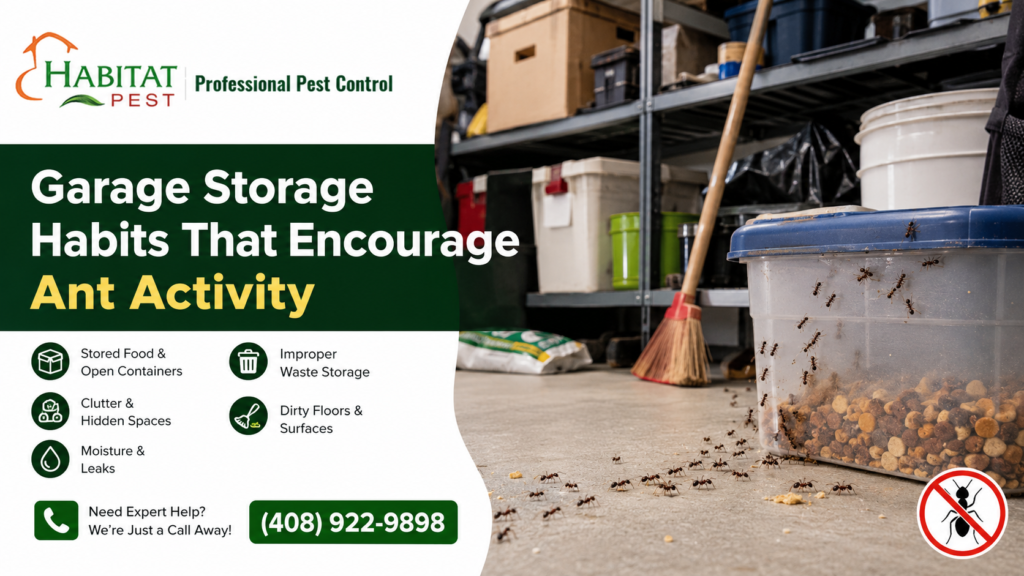
Dry pet food left in open bags or loosely covered containers sends a chemical signal that ants detect from a surprising distance. Argentine ants, one of the most aggressive and structurally invasive species in California, are strongly attracted to protein and fat-based food sources. A 10-pound bag of dog kibble sitting in the corner of your garage can sustain a foraging colony for weeks.
Airtight containers with locking lids are the practical fix. Glass or heavy-duty plastic works well. Thin plastic bags offer almost no barrier because ants can chew through them or find the unsealed folds.
Moisture Is the Silent Trigger Most People Miss
Food gets all the attention, but moisture is equally important in understanding why ants target garages. Leaking pipes under utility sinks, condensation on concrete floors, and water pooling near the garage door threshold all create the kind of damp environment that ant colonies prefer for nesting. Odorous house ants, in particular, are strongly drawn to moisture-rich zones.
Here is what commonly creates moisture problems in garage storage areas:
• Overwatered plants stored near the garage wall, causing soil runoff and damp corners
• Wet cardboard or paper bags left on the floor after grocery hauls or deliveries
• Dripping utility sinks or hose connections that never fully dry between uses
• Garage door seals that are cracked or warped, allowing rainwater to seep underneath
• Concrete floor condensation in humid months, especially in poorly ventilated garages
Fixing moisture issues is not a cosmetic upgrade. It directly removes one of the core reasons ants choose your garage over the outdoors.
Trash and Recycling Bins Left Unsealed Create a Feeding Station
Recycling bins are a frequently ignored ant magnet. Rinsed cans and bottles still carry residue, and that residue is enough to attract scouts. Soda cans, juice bottles, and food packaging all leave behind sugar and organic material that ants locate quickly. Keeping recycling bins inside the garage without lids is essentially leaving out a buffet.
Trash cans with tight-fitting lids and regular emptying schedules reduce this risk considerably. Rinsing recyclables before binning them helps too, even if it feels like an unnecessary step.
Stacked Firewood Against the Garage Wall Is a Nesting Ground
Firewood stored inside or directly against the garage wall is one of the most reliable ways to introduce carpenter ants and other wood-nesting species. Logs retain moisture, especially after rain, and the bark provides insulation that ant colonies use to regulate nest temperature. Carpenter ants do not eat wood, but they excavate it to build galleries, and that structural damage compounds over time.
A pest inspector in Cupertino will flag indoor or wall-adjacent firewood storage in almost every inspection where wood-boring ants are present. The fix is simple: store firewood at least 20 feet from the structure and never bring more inside than what you will burn the same day.
Cluttered Shelving Makes Inspection and Monitoring Nearly Impossible
Dense clutter along garage walls and shelving units creates zones that almost never get cleaned or inspected. Ants nest in quiet, undisturbed areas, and a shelf packed with old tools, seasonal decorations, and unused equipment gives them exactly that. The problem is not the clutter itself but the fact that infestations can develop undetected for months in those spaces.
Organized shelving, spaced properly from the wall and kept off the floor, allows you to spot ant trails, frass, or moisture damage early. Early detection reduces treatment complexity and cost by a wide margin.
Gaps in the Garage Floor and Walls Go Unnoticed for Years
Expansion joints in concrete floors, gaps around conduit entries, and cracks in the drywall behind shelving units are all common ant entry points. These structural gaps are not dramatic, but they do not need to be. Pavement ants can enter through a crack as thin as 1.5mm. Sealing these with appropriate caulk or concrete filler removes entry routes that ants have been using for years without anyone realizing it.
Answers Homeowners Actually Need: Ant Activity in Garage Spaces
Q1. Why are ants more common in garages than in other parts of the home?
A1. Garages have multiple entry points, temperature fluctuations, stored food items, and moisture-prone surfaces. They also receive less frequent cleaning and inspection, making them ideal for ant colonies to establish foraging trails undetected.
Q2. What ant species most commonly infest garage storage areas?
A2. Argentine ants, odorous house ants, carpenter ants, and pavement ants are the most frequently found species in garage environments. Each targets different resources, ranging from food residue and moisture to wood and concrete gaps.
Q3. Can ants in the garage spread to the rest of the house?
A3. Yes. Garages are typically connected to the main structure, and ant trails established in the garage will extend toward kitchens, pantries, and wall voids over time. Early control in the garage prevents larger interior infestations.
Q4. How does cardboard storage encourage ant nesting?
A4. Cardboard retains moisture and heat, which carpenter ants and odorous house ants use for nesting. Floor-level cardboard boxes near the foundation are especially high-risk because they sit closest to common entry points.
Q5. Is firewood storage inside the garage a significant risk factor?
A5. Yes. Firewood harbors carpenter ants, moisture ants, and other wood-nesting species. Logs retain humidity and provide insulation, making them attractive nesting sites. Firewood should be stored away from the structure and never kept indoors long-term.
Q6. How do ants detect food in sealed garage spaces?
A6. Ants use chemoreceptors to detect volatile organic compounds released by food. Even tightly packaged items emit trace odors. Thin plastic bags and loosely sealed containers do not block these chemical signals effectively.
Q7. What is the role of moisture in ant infestations?
A7. Moisture attracts species like odorous house ants and moisture ants, which prefer damp nesting sites. Leaking pipes, condensation, wet storage materials, and faulty door seals all contribute to conditions that draw ant colonies indoors.
Q8. When should a homeowner call a professional instead of using store-bought ant treatments?
A8. Store-bought baits and sprays address surface activity but rarely eliminate the colony. If trails reappear within days, if multiple species are present, or if carpenter ant damage is suspected, professional inspection and treatment are necessary.
Your Garage Deserves the Same Attention as the Rest of Your Home
Ants find your garage because something inside is working in their favor, food, moisture, clutter, or a structural gap. Better storage habits reduce that risk, but they cannot eliminate an active colony. Once trails are established, professional treatment becomes necessary.
Habitat Pest Control locates the source before treating anything. Our inspections cover foundation gaps, moisture zones, and entry points. We as an exterminator in San Jose will identify the species and apply the right targeted treatment.