
Summary:
Argentine ants and carpenter ants might look similar crawling across a countertop, but they behave, nest, and cause damage in completely different ways. Understanding this difference is exactly why ant control in Mountain View requires two separate strategies instead of one blanket spray that barely touches either species.
Two Ants, Two Completely Different Problems
Two ants that look almost identical can destroy your home in completely different ways. Most homeowners assume every ant problem gets solved the same way: spray something strong and move on.
However, Argentine ants and carpenter ants live, eat, and build nests so differently that treating them the same way usually fails one species while barely slowing the other. That’s exactly why proper ant control in Mountain View starts with identifying the species first, not just reaching for the nearest spray. Knowing which ant you’re actually dealing with changes everything about the plan that follows.
What Makes Argentine Ants So Hard to Control
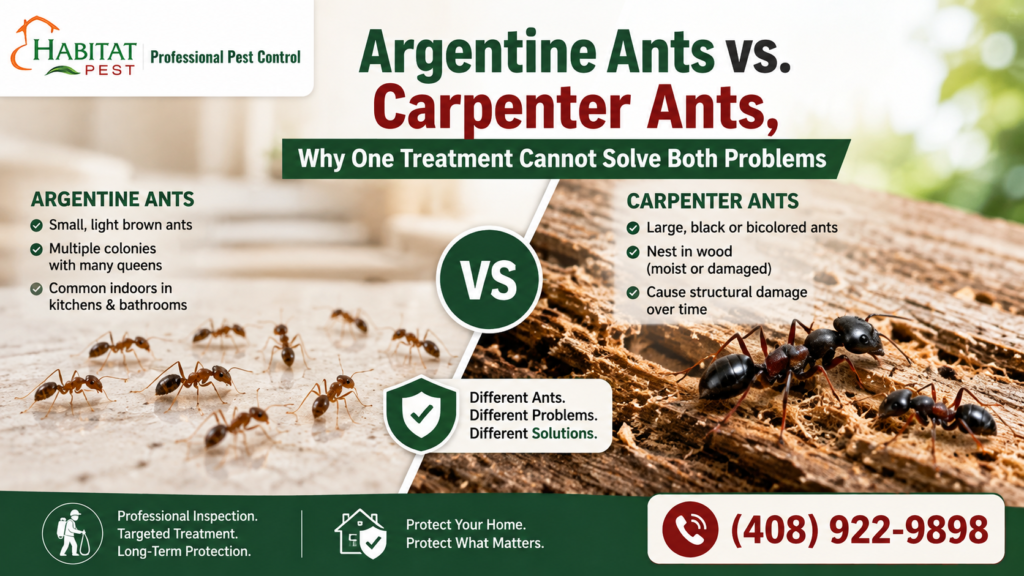
Argentine ants are small, light brown, and travel in massive trails that seem to appear out of nowhere. They don’t just live in one nest; they form supercolonies with thousands of interconnected queens spread across multiple locations. Killing the ants in your kitchen barely dents the larger network still thriving somewhere in your yard.
This species also avoids fighting other Argentine ant colonies nearby, which sounds strange but actually helps them spread faster. Because they cooperate instead of competing, a single supercolony can stretch across several properties in a neighborhood. That’s part of why store-bought sprays rarely fix the problem long-term, since killing visible trails does nothing to the queens producing new workers daily elsewhere.
Why Carpenter Ants Cause a Completely Different Kind of Damage
Carpenter ants tell a different story entirely. These larger, dark-colored ants don’t eat wood as termites do; they excavate it to build smooth tunnels for nesting. Over months or years, this hollowing weakens support beams, window frames, and other structural wood without any obvious outdoor sign.
A single carpenter ant colony usually has one main nest and several smaller satellite nests nearby. Moisture-damaged wood attracts them first, often near leaky roofs, bathroom walls, or areas around window sills. An ant exterminator in San Jose dealing with carpenter ants focuses heavily on locating these satellite nests, since missing even one allows the colony to rebuild fast.
Colony Structure Explains Why Treatment Differs So Much
Colony size and structure drive nearly every decision a technician makes during treatment. Argentine ant supercolonies demand broad, perimeter-based baiting that targets multiple entry points across a property at once. Carpenter ants require a more surgical approach, locating specific nests hidden inside walls or wood rather than treating the whole yard.
Using a broad perimeter spray on carpenter ants often misses the actual nest completely, since these ants might be tunneling three rooms away from where you spotted them.
On the flip side, trying to spot-treat a single Argentine ant trail does almost nothing against a supercolony spanning dozens of yards. This mismatch explains why so many homeowners feel frustrated after treating the same ant problem twice with no lasting results.
Where Each Species Tends to Nest
Knowing where to look changes the entire inspection process. A few common nesting patterns show up again and again across service calls:
• Argentine ants often nest under mulch, potted plants, or near irrigation lines with steady moisture
• Carpenter ants prefer damp, softened wood near roof leaks, deck posts, or bathroom plumbing
• Argentine ant trails frequently follow sidewalk cracks or foundation edges toward kitchens
• Carpenter ant activity often includes small piles of sawdust-like debris called frass near baseboards
Spotting these clues early helps narrow down which species you’re actually facing before treatment even begins.
Bait Choice Makes or Breaks the Results
Bait formulas aren’t interchangeable between these two species either. Argentine ants respond well to sugar-based liquid baits, since their diet leans heavily toward sweet food sources during most of the year. Carpenter ants prefer protein-based baits, especially during spring and early summer when colonies focus on feeding developing larvae.
Using the wrong bait type wastes both time and money, since ants simply ignore food that doesn’t match their current dietary preference. A technician familiar with seasonal ant behavior adjusts bait formulas throughout the year instead of applying the same product regardless of species or season.
How Moisture Control Plays Into Both Problems
Moisture management matters for both species, though for slightly different reasons. Argentine ants need consistent water access nearby, so fixing irrigation leaks and improving drainage reduces their food and hydration sources significantly. Carpenter ants need damp wood specifically, meaning roof repairs and proper attic ventilation matter more than yard drainage in most cases.
A home with both species present, which happens more often than people expect, usually has multiple moisture issues at once. Addressing only one source often leaves the other ant problem completely untouched.
Why DNA-Level Identification Actually Matters
Correct identification sounds like a small detail, but it changes the entire treatment timeline. Argentine ant supercolonies can take several weeks of consistent baiting to fully collapse, since eliminating thousands of interconnected queens doesn’t happen overnight. Carpenter ant nests, once located accurately, often clear up faster because treatment targets a smaller, more concentrated colony structure.
Misidentifying the species at the start leads to wasted treatment cycles and continued damage, especially with carpenter ants quietly weakening wood the entire time.
Getting this step right from day one saves both money and structural headaches down the road.
Frequently Asked Questions About Argentine and Carpenter Ant Control
Q1: How can I tell Argentine ants and carpenter ants apart at home?
A1: Argentine ants are small and light brown, while carpenter ants are larger, darker, and often leave sawdust-like debris near nests.
Q2: Why does one treatment fail against both ant species?
A2: Each species nests differently and responds to different bait types, so a single generic treatment usually misses one problem entirely.
Q3: Do carpenter ants actually eat the wood they tunnel through?
A3: No, carpenter ants excavate wood to build nests but don’t consume it the way termites do.
Q4: How long does it take to eliminate an Argentine ant supercolony?
A4: Full elimination often takes several weeks, since baiting must reach multiple interconnected nests and queens across the property.
Q5: What attracts carpenter ants to a specific area of a home?
A5: Moisture-damaged wood near leaky roofs, bathrooms, or window frames draws carpenter ants toward nesting sites.
Q6: Is it common for both ant species to infest the same property?
A6: Yes, homes with multiple moisture issues sometimes support both species at once, requiring separate treatment approaches for each.
Q7: Does bait type really change results between these two species?
A7: Definitely, Argentine ants prefer sugar-based bait, while carpenter ants respond better to protein-based bait during active feeding months.
Q8: Can DIY sprays solve either type of ant infestation long-term?
A8: Rarely, since sprays kill visible ants but leave the main nest or supercolony structure untouched and active.
Two Ant Problems, One Smarter Way to Solve Them Both
Treating Argentine ants and carpenter ants as one issue almost guarantees you’ll be dealing with at least one of them again soon. Getting the species right from the start, then matching that identification to actual nesting behavior, is what separates a lasting fix from a temporary patch.
At Habitat Pest Control, identification always comes before treatment, never the other way around. Therefore, if ants keep showing up no matter what you’ve already tried, our ant exterminator team in San Jose is ready to find out what’s really going on and put an end to it properly.